




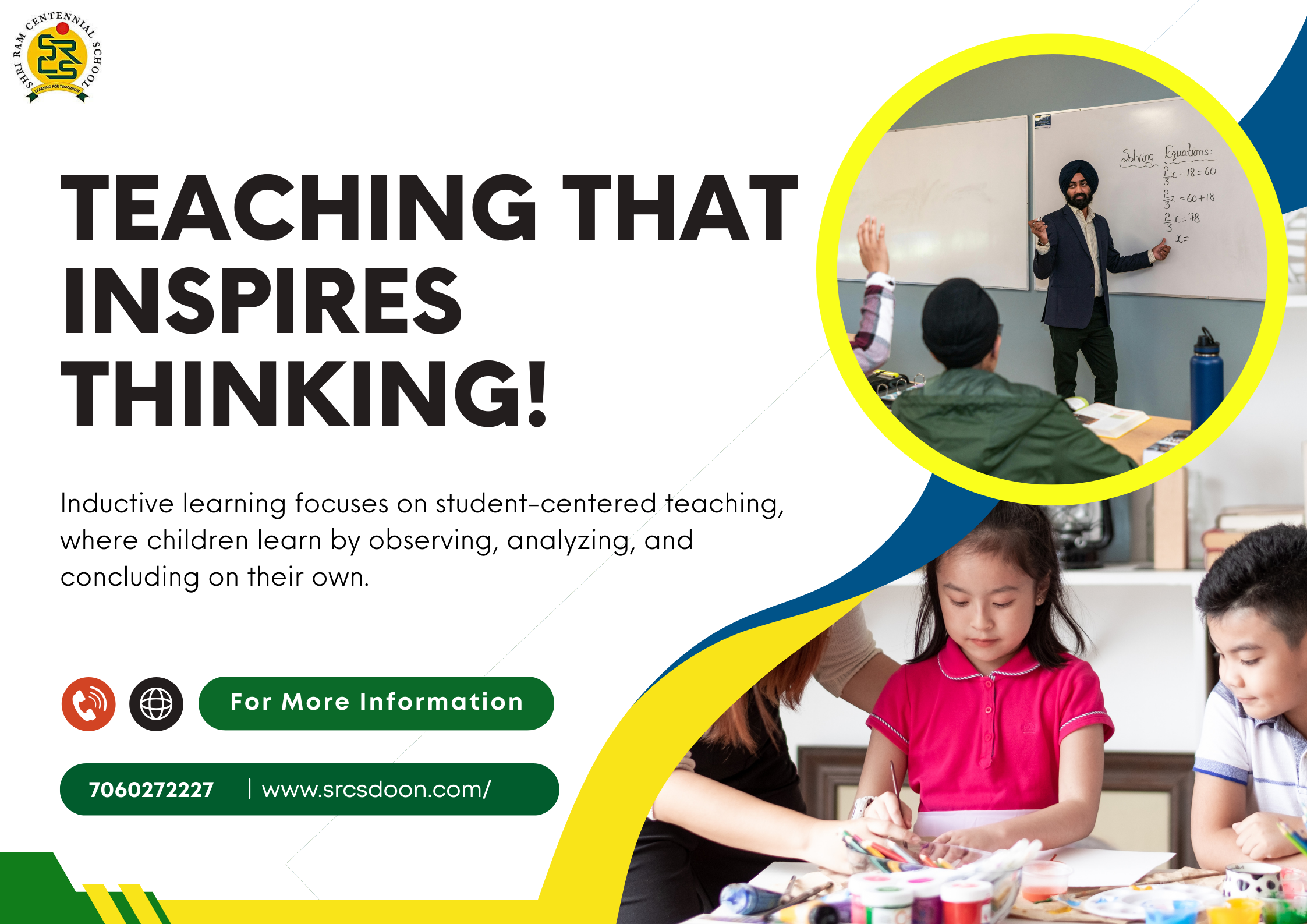
Teaching is more than passing on information—it’s about sparking curiosity. One powerful way to do this is through the inductive method of teaching. Unlike traditional teaching, which begins with rules and theories, the inductive method starts with examples and guides students to discover concepts on their own.
Whether you’re teaching in a city classroom or a Boarding school in india, this approach makes learning engaging, interactive, and memorable. In this blog, we’ll simplify the inductive method, share real-life examples, highlight its advantages, and show teachers how to use it effectively in their classrooms.
Why Teachers Should Use the Inductive Method

The inductive approach works because it mirrors how humans naturally learn—by observing and connecting experiences. Some benefits include:
-
More engaging: Students enjoy discovering answers themselves.
-
Improves memory: Concepts stick longer when self-discovered.
-
Encourages critical thinking: Students analyze and reason.
-
Promotes creativity: There’s room for multiple perspectives.
-
Supports holistic development: It nurtures intellectual, emotional, and social skills.
This makes it ideal for modern teaching strategies in schools.
Inductive vs Deductive Method
It’s easy to confuse the two, so let’s clear it up:
| Aspect | Inductive Method | Deductive Method |
|---|---|---|
| Approach | Start with examples | Start with rules |
| Learner’s Role | Active | Passive |
| Focus | Discovery & understanding | Memorization & application |
| Best For | Building concepts | Practicing known rules |
Both methods are useful, but the inductive method of teaching is more effective for developing critical thinking and deep understanding—especially in schools that encourage modern teaching strategies.
Why Teachers Should Use the Inductive Method
Here’s why this method is gaining popularity in classrooms :
-
Makes learning interesting – Students feel curious because they’re discovering knowledge.
-
Boosts retention – What students learn by observing stays longer in memory.
-
Encourages active participation – Students take charge of learning.
-
Develops critical thinking – Learners analyze, compare, and draw logical conclusions.
-
Works across subjects – From math to history, it’s adaptable everywhere.
Step-by-Step Process of the Inductive Method of Teaching
Teachers can apply the inductive method in almost any subject by following these steps:
1. Start with Examples
Provide students with real-life examples, objects, or activities.
2. Ask Guiding Questions
Encourage them to notice similarities, differences, or patterns.
3. Facilitate Discussion
Let students share their ideas and compare observations.
4. Form Generalizations
Guide them to discover the rule, law, or principle behind the examples.
5. Apply & Practice
Give students activities to apply the newly discovered knowledge.
Example in Mathematics: Instead of saying “even numbers are divisible by 2,” ask students to observe numbers like 2, 4, 6, 8 and see what they have in common.
Real-Life Examples of Inductive Method of Teaching

-
Science: Show different objects sinking or floating. Students discover why some float (density).
-
English: Give a few past tense sentences and ask students to identify the rule.
-
History: Share events of the freedom movement, then ask students to figure out common causes.
-
Geography: Show climate data for different regions and let students infer the climate pattern.
This approach is particularly effective in a boarding school in india, where students learn through both classroom and daily life experiences.
Advantages of the Inductive Method of Teaching
-
Highly engaging – Keeps students attentive.
-
Promotes self-learning – Students learn to find answers themselves.
-
Long-term understanding – Students don’t just memorize; they understand.
-
Encourages creativity – Students approach problems from different angles.
-
Supports holistic education – Works well with life skills, critical thinking, and collaboration.
Challenges of the Inductive Method of Teaching
Like any teaching approach, it has its limitations:
-
Time-consuming: Takes longer than lecture-based teaching.
-
Requires planning: Teachers must design examples carefully.
-
Not suitable for all topics: Some concepts may need direct explanation.
Still, most teachers find the advantages outweigh the challenges. Combining inductive and deductive methods often works best.
Why the Inductive Method of Teaching Works Well in Boarding Schools
In a Boarding school in India, students spend more time together and are naturally exposed to teamwork, problem-solving, and independent thinking. That’s why inductive teaching fits perfectly:
-
Students collaborate in group activities.
-
They connect classroom lessons with real-life experiences.
-
Learning doesn’t stop at the classroom—it continues in dorms, playgrounds, and labs.
This makes education in boarding schools holistic, balanced, and practical.
Best Practices for Teachers

-
Use visual aids (charts, diagrams, videos).
-
Involve students in group discussions.
-
Use real-world examples (sports, nature, daily life).
-
Ask open-ended questions.
-
Encourage students to explain their reasoning.
When done right, the inductive method can turn any classroom into an exciting space for discovery.
Conclusion
The inductive method of teaching is more than just a classroom strategy—it’s a way to make learning interactive, fun, and meaningful. By starting with examples and letting students discover rules, teachers encourage curiosity and critical thinking.
For schools, especially a Boarding school in India, this method blends perfectly with holistic education by encouraging independent learning and teamwork.
Frequently Asked Questions(FAQs)
Q1. What is the inductive method of teaching in simple words?
It’s a teaching style where lessons start with examples, and students figure out the rules or concepts themselves.
Q2. Why is the inductive method effective?
Because students actively participate in learning, it improves memory, creativity, and critical thinking.
Q3. Can the inductive method be used in all subjects?
Yes, it works in subjects like math, science, history, and grammar, but some abstract topics may still need direct explanation.
Q4. What are the main disadvantages of the inductive method?
It requires more time, planning, and sometimes may confuse weaker students without proper guidance.
Q5. Is the inductive method used in boarding schools?
Yes, it works very well in a Boarding school in india, where students live and learn together, making group discovery learning easier and more practical.