


Education has always evolved alongside society’s needs. While technology, curriculum frameworks, and teaching tools continue to change, some instructional approaches remain timeless. One such approach is the Socratic Method, a questioning-based teaching style that emphasizes dialogue, reasoning, and reflection rather than memorization.
This article explores what the Socratic Method is, how it works step by step, why it remains relevant today, and the challenges educators face while applying it in contemporary classrooms.
What Is the Socratic Method?
The Socratic Method is a teaching approach rooted in guided questioning. Instead of delivering direct answers, educators ask carefully structured questions that lead students to examine assumptions, analyze reasoning, and arrive at conclusions independently.
Named after the Greek philosopher Socrates, this method was originally used as a tool for philosophical inquiry. In modern classrooms, it functions as a learner-driven discussion technique that prioritizes reasoning over rote learning.
At its core, the Socratic Method treats learning as an active process. Students are not passive recipients of information; they are participants who explore ideas through dialogue and thoughtful questioning.
Why the Socratic Method Matters in Modern Education

Modern education increasingly values understanding, adaptability, and independent thinking. Traditional lecture-based instruction often limits student participation, while inquiry-driven methods promote engagement and clarity.
The Socratic Method supports this shift by helping learners:
-
Develop reasoning and analytical abilities
-
Articulate ideas with confidence
-
Engage respectfully with diverse perspectives
-
Reflect on their own thought processes
As classrooms move toward learner-centered instruction, this method aligns naturally with educational goals focused on comprehension rather than memorization.
The Five Essential Steps of the Socratic Method
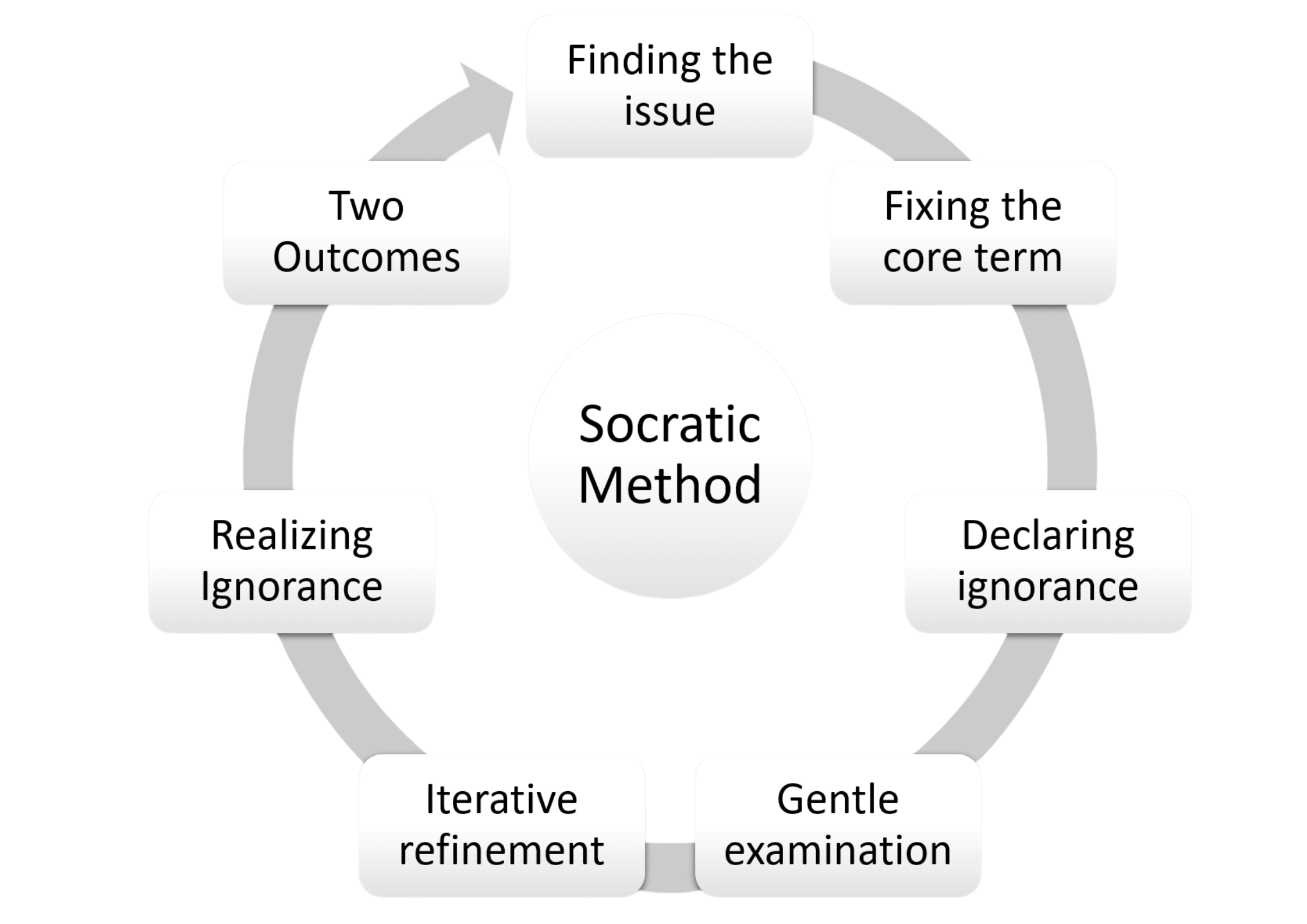
While discussions may feel spontaneous, effective Socratic teaching follows a structured progression. These five steps help educators guide students without dominating the conversation.
1. Clarifying the Topic or Question
The process begins by identifying a central question or concept. This ensures that discussion remains focused and meaningful. Educators often ask open-ended questions that invite explanation rather than yes-or-no responses.
This step sets the foundation for deeper inquiry.
2. Examining Assumptions
Once the topic is clear, learners are encouraged to identify assumptions behind their thoughts. Questions such as “Why do you think this is true?” help students recognize beliefs they may have accepted without examination.
This stage fosters self-awareness and intellectual honesty.
3. Exploring Evidence and Reasoning
Students are then guided to support their ideas with logic, examples, or evidence. Instead of correcting mistakes directly, educators pose follow-up questions that help learners evaluate the strength of their reasoning.
This step strengthens analytical thinking and accountability in discussion.
4. Considering Alternative Perspectives
Discussion expands as students are invited to consider different viewpoints. Questions like “Is there another way to look at this?” help broaden understanding and reduce rigid thinking.
This phase encourages empathy and open-mindedness.
5. Reflecting on Conclusions
The final step involves reflection. Learners summarize insights, reassess earlier assumptions, and articulate what they have learned. Reflection reinforces understanding and helps students internalize concepts.
This step completes the learning cycle by connecting inquiry with clarity.
How the Socratic Method Is Used in Classrooms Today

In modern educational settings, the Socratic Method is adapted to suit different age groups, subjects, and learning environments.
Application Across Subjects
-
Humanities: Encourages debate, interpretation, and ethical reasoning
-
Science: Promotes hypothesis testing and conceptual understanding
-
Mathematics: Helps students explain problem-solving processes
-
Social Sciences: Builds reasoning around real-world issues
Many institutions, including Top schools in india, integrate discussion-based teaching to strengthen conceptual clarity and communication skills.
Benefits of the Socratic Method
When applied effectively, this approach offers several long-term advantages.
Builds Independent Thinkers
Students learn how to think rather than what to think. This independence prepares them for academic challenges and real-life decision-making.
Encourages Active Participation
Learners are more engaged when their ideas matter. The method creates a classroom culture where questioning is valued.
Improves Communication Skills
Regular dialogue helps students express ideas clearly, listen attentively, and respond respectfully.
Promotes Deeper Understanding
By examining ideas from multiple angles, students gain lasting conceptual clarity rather than surface-level knowledge.
Challenges of Using the Socratic Method

Despite its benefits, the Socratic Method is not without limitations.
Time Constraints
Meaningful discussions require time, which can be challenging within rigid curricula.
Teacher Skill and Preparation
Effective questioning demands training and experience. Poorly framed questions may lead to confusion rather than insight.
Student Readiness
Not all learners are immediately comfortable with open discussion. Some may need encouragement and gradual exposure.
Assessment Difficulties
Measuring learning outcomes from discussion-based instruction can be more complex than traditional testing.
Balancing Structure and Freedom
Successful implementation depends on balance. Educators must guide discussions without controlling them, allowing students to explore while maintaining academic direction.
When structured thoughtfully, the Socratic Method complements modern instructional strategies rather than replacing them.
Conclusion: Why the Socratic Method Remains Relevant
The Socratic Method continues to hold value because it aligns with the core purpose of education: developing thoughtful, capable individuals. In a world where information is easily accessible, the ability to question, analyze, and reason matters more than ever.
By fostering dialogue, reflection, and independent thinking, this method prepares learners for both academic success and lifelong learning. Its adaptability ensures that, even in evolving educational environments, meaningful inquiry remains at the heart of effective teaching.
Frequently Asked Questions
Q 1: What is the Socratic Method in simple terms?
Answer: It is a teaching approach where educators ask guided questions to help students think critically and discover answers on their own.
Q 2: Is the Socratic Method suitable for school students?
Answer: Yes, when adapted properly, it helps school students improve reasoning, communication, and understanding across subjects.
Q 3: How does the Socratic Method improve learning outcomes?
Answer: It strengthens analytical thinking by encouraging students to explain ideas, question assumptions, and reflect on conclusions.
Q 4: Can the Socratic Method be used in online or digital classrooms?
Answer: Yes, it works well in digital settings through guided discussions, interactive tools, and structured questioning.
Q 5: What is the main limitation of the Socratic Method?
Answer: It requires skilled facilitation and sufficient class time, which can be challenging in tightly scheduled curricula.