The world as we know it is evolving at a phenomenal speed. Today, new and ever more fascinating advancements in the sciences and technology have altered our work processes, the way we communicate with each other, as well as our lives. We see that the Artificial intelligence and robotics, or perhaps the biotech sector, or clean energy technologies are constantly evolving and shaping our tomorrow-and they all need people who are innovative and who are problem solvers.
As a result, a lot of modern curricula have adopted STEM education as part of the curriculum.
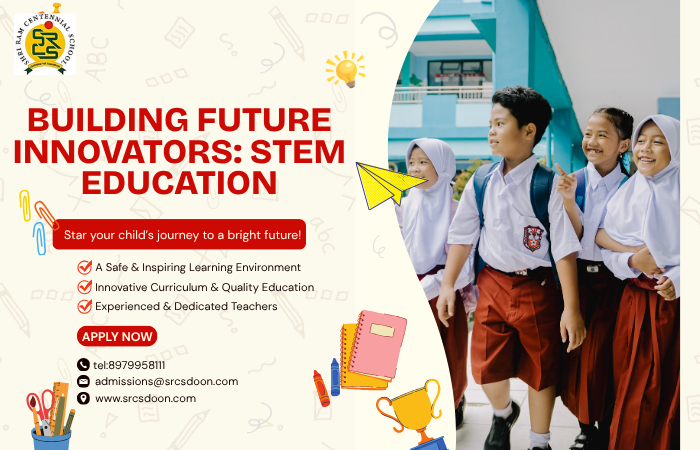
Through offering SRCS students opportunities for collaborative projects that bridge across the science, technology, engineering and maths spectrums of learning, children are armed with the relevant skills and information they need. Our STEM Education curriculum Learn how STEM education at SRCS fosters creativity, critical thinking, problem-solving and innovation for future careers. is fundamental in developing children that are inquisitve, innovative and also confident future leaders. STEM education involves the child asking, testing and working together as a group in lieu of teacher-led lessons or textbook reading as it enables the child to devise solutions to some of the more intricate real-world challenges and problems, understanding the link between different classroom subjects with the outside world.
What Is STEM Education?
In STEM education, each of the abbreviations refers to S-Science T-Technology E-Engineering M-Maths.
The Science aspect helps students gain a better understanding of the world around us, The technology component encourages learners to get the hands-on experience using different tools and technologies, While engineering allows learners to design and create viable solutions to challenges, utilising their logical skills and math knowledge. If they can combine these different aspects of knowledge and skills, they will become a comprehensive problem solver and can think creatively to design.
Promotes Inquiry-Based Learning & Critical Thinking
One of the first ways to develop your child’s mind is by introducing them to wonder!
It is essential that a child be allowed to pose the ‘what ifs’ in their head and feel safe in exploring their ideas. At SRCS, we’re about creating an encouraging and supportive learning environment where children aren’t just learning facts and figures but are instead engaging in projects that allow them to do research, test theories, and observe the results first hand to come up with their own conclusions. Learning how classroom subjects are tied to real-world problems encourages a more investigative and deeper way of thinking and problem-solving, leading children to develop logical reasoning, the ability to make informed decisions, and take action on knowledge that they acquire.
Learning Through Practical Experiences
At SRCS, hands-on learning is integrated throughout our curriculum, with a strong focus on experimentation.
When we are all busy creating, exploring, and manipulating, we learn things better! Through stimulating projects related to science, robotics, coding, mathematics, and technology, students gain confidence as they apply these concepts in real-life scenarios. For instance, students may construct working models in a physics lesson, or write simple code to complete specific tasks in a computer programming course. They develop a better understanding of what they are learning when it is tangible and relates to practical applications.
Teaching Problem-Solving Skills
What is particularly remarkable about the STEM approach is the opportunity it provides for teaching problem-solving skills.
With many SRCS STEM programs, learners are presented with tasks or questions that may have several possible answers, and they will engage in steps of identifying issues, proposing solutions, testing and evaluating their solutions and finally redesigning as required. We make sure our students know that if a design fails on the first attempt, that’s OK! They’ll learn patience, flexibility, logic and resourcefulness and they’ll be reminded that failure is part of the innovation process.
Fostering collaboration, team-work and communication It’s unlikely that innovation occurs in isolation; more likely, a successful outcome results from the work of an array of different individuals – engineers, designers, scientists, etcetera. The SRCS curriculum places a significant emphasis on fostering team-working and communication skills among students. We help them develop strategies to share tasks, brainstorm ideas, communicate their thinking clearly and to work collaboratively towards a common goal or project outcome.
This collaborative methodology reinforces their learning and simultaneously imparts crucial life skills, such as leadership and the capacity for productive teamwork, which are both invaluable as they proceed to higher education and their career.
Creativity and innovation are key skills at STEM Education
The STEM curriculum fosters an innovative approach to education, focusing on logical reasoning and analytical thinking to stimulate innovative solutions and unconventional perspectives. We want our children to look beyond the conventional and encourage creativity through design solutions for technological prototypes, scientific investigations and engineering models.
Developing student readiness for future careers
With a global workforce and an increased dependence on technology, job prospects in STEM fields such as Artificial intelligence and Robotics, cybersecurity, and clean energy engineering, have been multiplying. By equipping our students with the requisite knowledge of the STEM areas, we enable them to not only to enter these competitive sectors, but also to develop informed future career choices, from technology, design, and healthcare to entrepreneurship and medicine.
A Teacher’s role in innovation and education
The role of a teacher cannot be underestimated and the SRCS faculty is proud of being an active member of the innovative learning community to successfully run these STEM programs.
They are not just imparting information to students, but they serve as guides, mentors and facilitators on each child’s path of discovery and experimentation. As students engage in spirited discourse, problem solving and experiments, they have the chance to become independent explorers in real world-relevant activities while a teacher will lead them through the curriculum to find solutions to their challenges.
Fostering self-confidence in students as innovators
Many parents, upon considering whether to expose their child to a STEM-based curriculum, express concerns about a child’s potential self-confidence.
On the other hand, successful problem-solving not only helps improve a child’s self-confidence and belief in their own abilities, but it also enables them to have the desire to seek and achieve more challenges. Because the STEM process relies on experimentation and iteration, and repetition, children learn a “growth mindset”; that is, if you keep practicing something over and over again you will eventually become skilled at it, which goes a long way in both the classroom and beyond.
Conclusion
The most significant effect a child can derive from STEM Education is self-confidence, since when children manage to overcome an challenge, be it simple or complicated, their self esteem levels increase and are likely to pursue greater and bigger tasks with more determination.
Because innovation depends on trial and error – learning and experimenting – our students learn to have a growth mind-set.
This way they learn patience, endurance, flexibility and develop their logical thinking skills. And at SRCS, our students learn that it’s OK to fail if that is what is required to create something great, after all failure is the pathway to learning and understanding.
FAQs
What is STEM education?
Ans. STEM education integrates Science, Technology, Engineering, and Mathematics to help students develop practical knowledge, critical thinking, creativity, and problem-solving skills.
Why is STEM education important for students?
Ans. STEM education prepares students for a rapidly changing world by developing skills such as innovation, analytical thinking, collaboration, and adaptability that are valuable for future academic and career opportunities.
How does STEM education encourage innovation?
Ans. STEM learning encourages students to experiment, ask questions, work on practical projects, and find solutions to real-world problems. This process helps them become creative and independent thinkers.
How does STEM education prepare students for future careers?
Ans. STEM education provides a foundation for emerging fields such as artificial intelligence, robotics, biotechnology, data science, engineering, and renewable energy while developing transferable skills useful across many professions.