





In today’s fast-paced academic and professional world, the ability to learn quickly has become more important than ever. Students are expected to grasp complex concepts in limited time, while professionals must constantly upgrade their skills to stay relevant.
This is where fast learning plays a crucial role. It is not about rushing through topics; instead, it focuses on understanding concepts efficiently, retaining information longer, and applying knowledge effectively.
This article explores the meaning of fast learning, its importance, and practical strategies students can use to become faster and smarter learners.
What Is Fast Learning?

It refers to the ability to understand, process, and retain new information in a shorter time without compromising clarity or accuracy. It is not limited to memorisation but involves comprehension, logical thinking, and application of concepts.
Fast learners:
-
Grasp ideas quickly
-
Make connections between topics
-
Retain information for longer periods
-
Apply knowledge confidently in exams and real life
Contrary to popular belief, it is not an inborn talent. It is a skill that can be developed with the right techniques and mindset.
Why It Is Important for Students

1. Saves Time
With multiple subjects, assignments, and exams, students often struggle with time management. Fast learning allows them to complete their syllabus efficiently, leaving time for revision and practice.
2. Reduces Exam Stress
When students understand concepts quickly and clearly, last-minute pressure decreases. Fast learning builds confidence and reduces anxiety during exams.
3. Improves Academic Performance
Students who learn faster can revise multiple times, practise more questions, and strengthen weak areas, leading to better academic results.
4. Builds Lifelong Learning Skills
Fast learning prepares students for higher education and future careers where continuous learning is essential.
Key Principles Behind Fast Learning
Before adopting techniques, it is important to understand the principles that support fast learning:
Focus over multitasking
Understanding over memorisation
Active learning over passive reading
Quality study time over long study hours
When these principles are followed, learning becomes faster and more effective.
Effective Strategies for Fast Learning

1. Set Clear Learning Goals
Before starting any topic, define what you want to learn. Clear goals help the brain focus only on relevant information and avoid distractions.
Example:
Instead of “study science,” aim for “understand photosynthesis and solve related questions.”
2. Break Topics into Small Parts
Large topics can feel overwhelming. Dividing them into smaller sections makes learning quicker and easier to manage.
This method, often called chunking, improves understanding and recall.
3. Use Active Learning Techniques
Active learning boosts fast learning by engaging the brain.
Some effective active learning methods include:
-
Teaching the concept to someone else
-
Writing short summaries in your own words
-
Solving practice questions
-
Creating mind maps or flowcharts
These techniques help information move from short-term to long-term memory.
4. Follow the Pomodoro Technique
Studying for long hours without breaks reduces efficiency. The Pomodoro Technique involves:
-
Studying for 25 minutes
-
Taking a 5-minute break
-
Repeating the cycle
This keeps the mind fresh and improves concentration, making learning faster.
5. Improve Reading Skills
Fast learning depends greatly on how you read.
To read effectively:
-
Avoid word-by-word reading
-
Focus on headings, keywords, and summaries
-
Highlight key points
-
Read with questions in mind
Smart reading saves time and improves comprehension.
6. Use Visual Aids
The brain processes visuals faster than text. Diagrams, charts, videos, and infographics make learning quicker and more engaging.
Visual learning is especially useful for subjects like science, geography, and mathematics.
7. Practice Retrieval
Instead of repeatedly rereading notes, try recalling information without looking. This method, known as retrieval practice, strengthens memory and speeds up learning.
Examples:
-
Self-testing
-
Flashcards
-
Writing answers from memory
8. Revise at the Right Time
Regular revision is essential for fast learning. Short, spaced revisions help retain information longer and reduce the need for last-minute cramming.
Role of Mindset

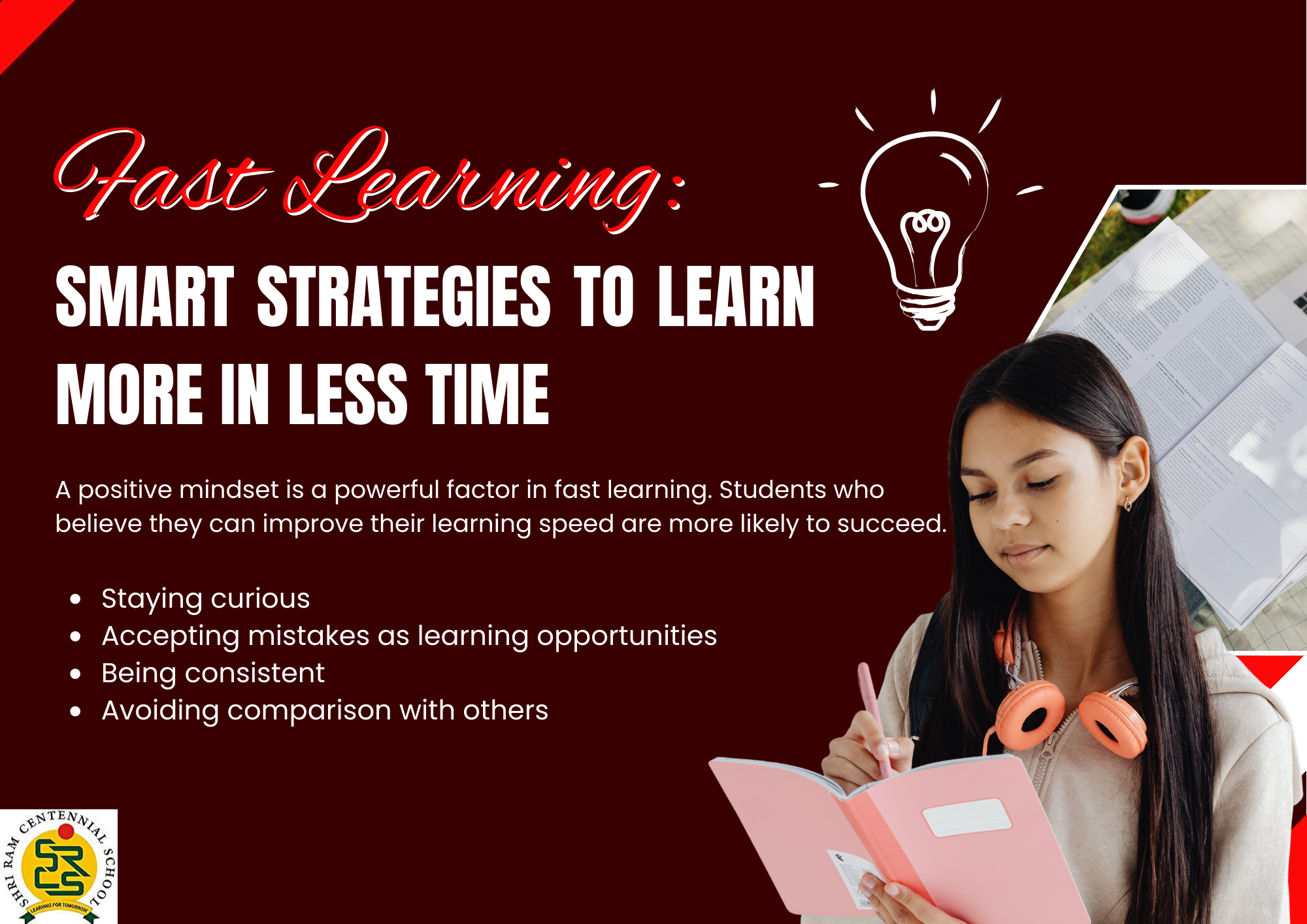
A positive mindset is a powerful factor in fast learning. Students who believe they can improve their learning speed are more likely to succeed.
Key mindset habits include:
-
Staying curious
-
Accepting mistakes as learning opportunities
-
Being consistent
-
Avoiding comparison with others
Confidence and discipline together make learning faster and more enjoyable.
Fast Learning vs Rote Learning
Many students confuse fast learning with rote learning, but they are very different.
| Fast Learning | Rote Learning |
|---|---|
| Focuses on understanding | Focuses on memorising |
| Long-term retention | Short-term recall |
| Encourages application | Limited practical use |
| Reduces stress | Increases exam pressure |
Fast learning promotes true knowledge, while rote learning often leads to confusion and forgetfulness.
How Teachers and Schools Can Support Fast Learning

Educational institutions play an important role in encouraging fast learning by:
-
Using activity-based teaching methods
-
Encouraging discussions and critical thinking
-
Integrating technology and digital tools
-
Focusing on concept clarity instead of syllabus completion
When students are taught how to learn, they automatically become faster learners.
Conclusion
It is not about studying harder; it is about studying smarter. By using the right strategies, maintaining focus, and developing a positive mindset, students can significantly improve their learning speed and academic performance.
In a world where knowledge is constantly evolving, fast learning is a valuable skill that benefits students not just in school, but throughout their lives.
By adopting fast learning techniques early, students can build confidence, reduce stress, and achieve consistent academic success.