


In today’s fast-changing world, success is no longer decided only by grades or degrees. The skills a person develops — both technical and personal — play an equal role in shaping their future. Students, parents, and educators often hear the terms hard skills and soft skills, but what do they actually mean? More importantly, why do they matter so much for a student’s journey from school to career?
This blog explains the meaning of both skill types, outlines five key hard skills and five essential soft skills, and shows how they work together to create confident, capable, and future-ready individuals.
The 5 Most Important Hard Skills
Below are five essential hard skills that students and professionals should focus on developing consistently:
1. Digital Literacy
In the modern era, understanding basic technology is no longer optional. Digital literacy includes the ability to use computers, smartphones, educational software, spreadsheets, and online platforms safely and effectively. Students who are digitally confident can research faster, collaborate better, and adapt to future careers with ease.
2. Writing and Language Proficiency
Strong writing skills help students express their ideas clearly in essays, reports, emails, and professional communication. This includes correct grammar, vocabulary, sentence structure, and the ability to organize thoughts logically. Whether in school or in the workplace, effective writing is a highly valued skill.
3. Data Handling and Basic Analysis
Many subjects today involve numbers, statistics, and interpretation of information. Understanding how to read charts, calculate data, and identify patterns is useful not only in mathematics or science but also in social sciences, economics, and business. This skill sharpens analytical thinking and decision-making ability.
4. Research Skills
The ability to find reliable information, compare sources, and present accurate facts is crucial for students. Research skills help in projects, assignments, presentations, and even real-world problem-solving. It teaches students how to evaluate what is true and what is misleading.
5. Subject-Specific Technical Skills
Every field has its own technical abilities. For example, a science student may need laboratory skills, an art student may require design techniques, and a commerce student must understand accounting tools. These subject-based skills define a student’s core competency and open doors to higher education or job opportunities.
The 5 Most Important Soft Skills
Hard skills may help someone get selected, but soft skills help them stay, grow, and lead. Here are five major soft skills students should develop:
1. Communication Skills
Clear speaking and attentive listening form the foundation of strong relationships. Whether it’s participating in a class discussion, giving a presentation, or interacting in a team, effective communication builds confidence and understanding.
2. Teamwork and Collaboration
In schools and professional spaces, most tasks are done in groups. Working well with others, respecting different opinions, and contributing fairly to a shared goal are qualities that define a successful team player.
3. Emotional Intelligence
This is the ability to understand one’s own emotions and the emotions of others. Students with emotional intelligence can control anger, handle stress, show empathy, and respond wisely in difficult situations. This skill leads to better friendships, leadership potential, and mental balance.
4. Adaptability
Life rarely goes exactly as planned. Adaptability is the skill that allows a student to adjust to new environments, learn from mistakes, and handle change without giving up. This is especially useful when facing new academic challenges, career shifts, or unexpected situations.
5. Problem-Solving Mindset
Instead of panicking when faced with a challenge, a problem-solver calmly looks for solutions. This skill helps in studies, exams, relationships, and future careers. It builds independence and confidence in decision-making.
Comparison Table: 5 Hard Skills vs 5 Soft Skills
| Hard Skills | What It Means | Soft Skills | What It Means |
|---|---|---|---|
| Digital Literacy | Ability to use computers, software, and online tools effectively | Communication Skills | Ability to speak, write, and listen clearly and confidently |
| Writing & Language Skills | Strong command over grammar, vocabulary, and expression | Teamwork | Ability to work cooperatively with others towards shared goals |
| Data Handling & Analysis | Understanding data, numbers, charts, and patterns | Emotional Intelligence | Ability to understand and manage emotions |
| Research Skills | Finding, verifying, and using reliable information | Adaptability | Ability to adjust smoothly to new changes and environments |
| Technical Subject Skills | Specialized knowledge related to a chosen field or subject | Problem-Solving Mindset | Ability to find logical and practical solutions to challenges |
Why Both Hard and Soft Skills Matter Together
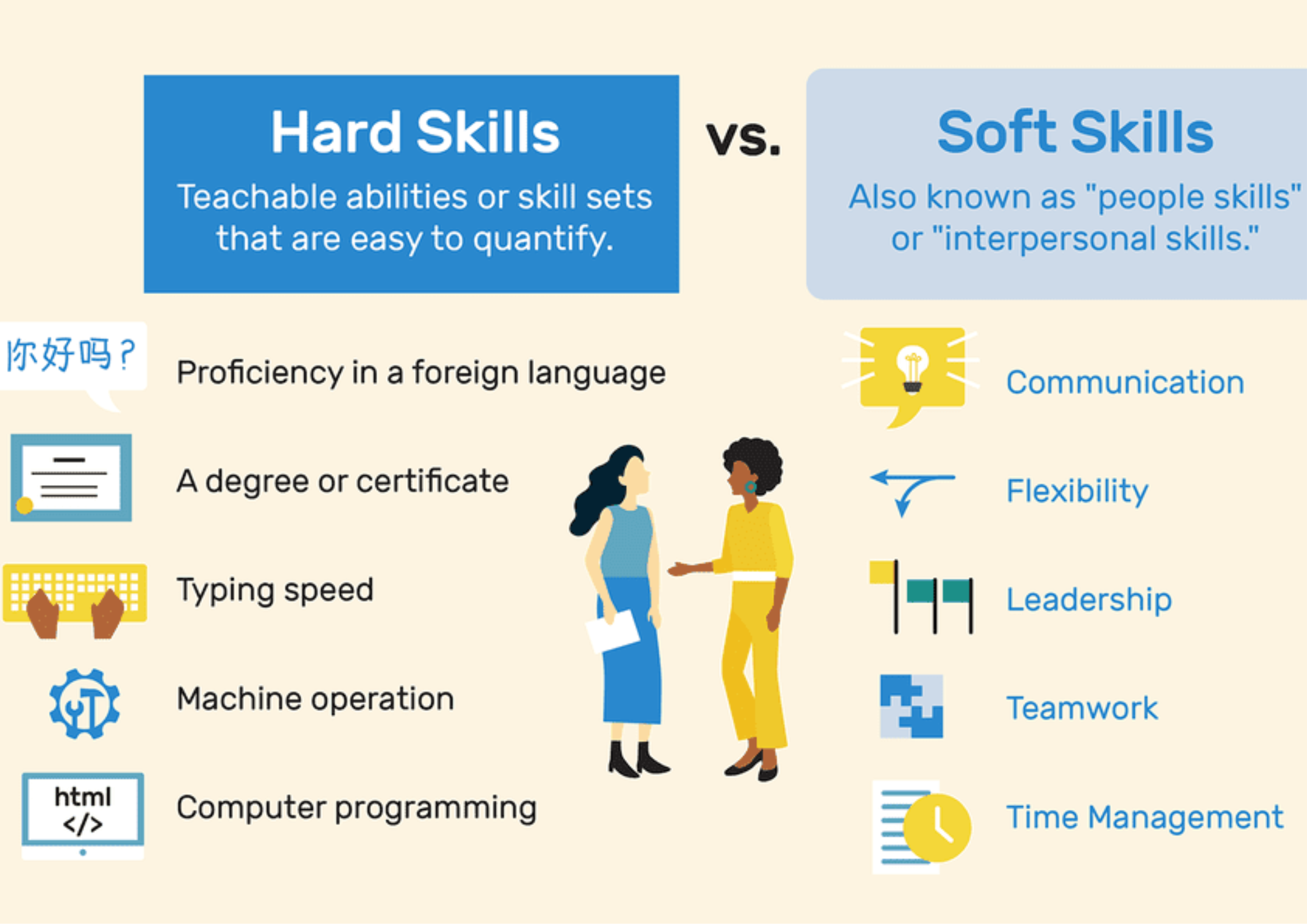
Hard skills and soft skills are not competitors — they are partners. One gives technical strength; the other adds human value. A student may score high in subjects but struggle in interviews because of a lack of confidence or communication ability. On the other hand, a confident speaker without technical knowledge will struggle to perform tasks.
The true power lies in balance. When students combine technical competence with strong interpersonal abilities, they become capable of leading, innovating, and adapting in any environment.
Employers, colleges, and institutions look for individuals who can not only perform tasks but also bring positive energy, clear thinking, and collaboration into their environment.
Challenges Students Face While Developing These Skills
Building skills is not always easy. Many students face challenges such as:
-
Lack of guidance or awareness
-
Fear of making mistakes
-
Limited opportunities to practice
-
Overdependence on academic scores
-
Hesitation in communication
These challenges can be overcome by consistent effort, encouragement from teachers and parents, and participation in activities that encourage growth, such as debates, presentations, internships, reading, and group projects.
How Schools and Parents Can Support Skill Development

Skill-building is a shared responsibility. Schools can introduce interactive learning, encourage public speaking, offer technical training, and provide career guidance. Parents can support children by listening, encouraging curiosity, respecting opinions, and motivating them to try new experiences.
When students grow in a supportive environment, their skills develop naturally and confidently over time.
Conclusion: Building a Balanced and Capable Generation
Understanding what hard skills and soft skills truly mean is the first step toward personal and professional growth. The next step is practice, patience, and proper guidance.
In a world full of competition and innovation, knowledge alone is not power — the right mix of skills is. By developing both technical abilities and human values, students prepare themselves not only for success in exams or interviews but for a meaningful, impactful life.
The goal is simple: nurture competence with character, intelligence with empathy, and ambition with responsibility. This balance is what creates leaders of tomorrow.
Frequently Asked Questions
1. What is the main difference between hard skills and soft skills?
Hard skills are technical and teachable, while soft skills are personal and behavioral qualities.
2. Can soft skills be learned like hard skills?
Yes, soft skills can be developed through practice, observation, and real-life experiences.
3. Which are more important for career success?
Both are equally important; hard skills open doors and soft skills help sustain growth.
4. How can students improve their hard skills faster?
Through regular practice, training, online courses, and consistent learning.
5. Why should schools teach soft skills early?
Early learning builds confidence, leadership, and strong interpersonal abilities in students.