






If you have ever read your notes the night before a test, felt confident, and then blanked on a question — you are not alone. The problem is not intelligence. The problem is timing. And the 1-4-7 Rule fixes exactly that.
This article breaks down what the 1-4-7 Rule is, how it works, why it outperforms traditional cramming, and how students, parents, and teachers can put it into practice starting today.
What is the 1-4-7 Rule of Revision?
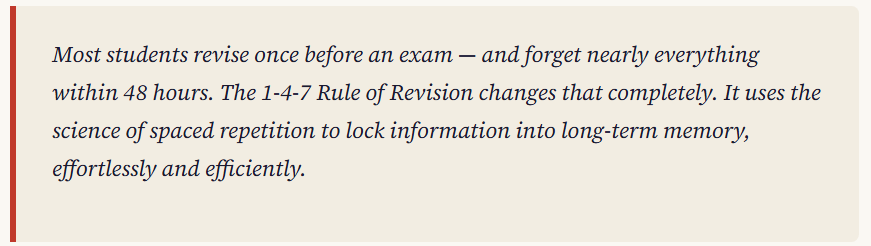
The 1-4-7 Rule of Revision is a structured study technique that schedules revision sessions on Day 1, Day 4, and Day 7 after first learning new material. Instead of reviewing everything at once, the rule spaces out repetition at carefully timed intervals — matching the natural rhythm of how the human brain stores memories.
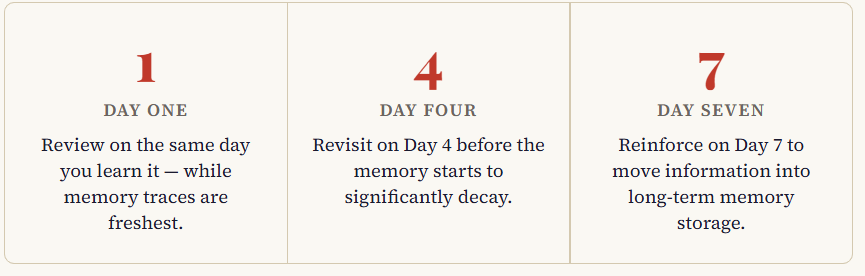
Quick Definition: The 1-4-7 Rule is a spaced repetition framework that schedules three review sessions — on Day 1, Day 4, and Day 7 — to significantly improve long-term memory and retention of studied material.
The Science Behind Spaced Repetition

The 1-4-7 Rule is rooted in cognitive science, specifically the concept of the forgetting curve — first identified by German psychologist Hermann Ebbinghaus in the 1880s. His research showed that people forget approximately 50% of new information within an hour, and up to 70% within 24 hours, if they do not actively review it.
Spaced repetition interrupts this forgetting process. Each time you revisit information at the right moment — just before it fades — your brain strengthens the neural pathways associated with that memory. Over time, the information becomes easier to recall and much more durable.
The 1-4-7 Rule provides a simple, memorable framework to apply spaced repetition without needing a complex algorithm or special software. It is practical, flexible, and works for any subject.
Why Traditional Cramming Fails
Cramming floods working memory with information all at once. The brain has limited capacity for short-term storage, and without spacing, most of what you study is overwritten or discarded. You may feel confident right after a cramming session — but that confidence is temporary.
The 1-4-7 Rule works differently. It trains your brain to actively retrieve information, not just re-read it. Active retrieval — the mental effort of recalling something — is one of the most powerful memory-strengthening tools known to science.
How to Apply the 1-4-7 Rule in Daily Study
Putting the 1-4-7 Rule into practice is straightforward. Here is a step-by-step approach:
- Learn the topic — attend the class, read the chapter, or watch the lecture.
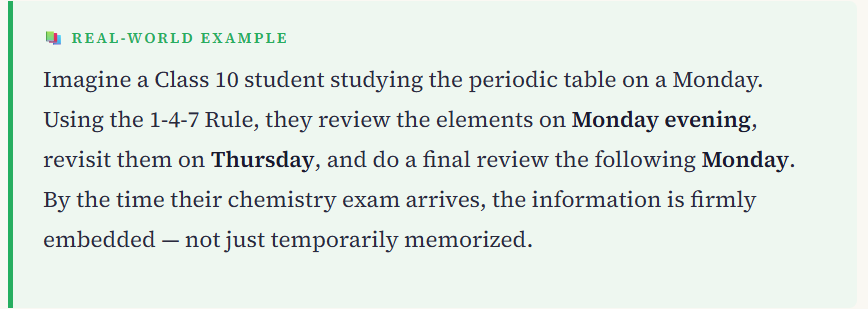
- Day 1 revision — that same evening, spend 10–15 minutes reviewing your notes. Write a brief summary from memory, then check it.
- Day 4 revision — four days later, revisit the topic again. Try to recall key points without looking at your notes first, then review what you missed.
- Day 7 revision — seven days after the original learning session, do a final consolidation review. At this stage, the information should feel familiar and much easier to recall.
Key Benefits of the 1-4-7 Revision Rule
The advantages of this study method extend far beyond just better exam scores. Here is why educators and memory researchers consistently support spaced revision:
- Stronger long-term memory: Information reviewed with spacing is retained for weeks or months, not just days.
- Less study stress: Short, scheduled sessions feel manageable — far less overwhelming than a last-minute marathon.
- Better exam confidence: Students who use spaced revision tend to feel genuinely prepared, not just hopeful.
- Works for all subjects: Whether it is mathematics, history, science, or language — the rule applies universally.
- Improves active recall: The gaps between sessions encourage the brain to actively retrieve, not passively re-read.
- Saves time overall: Three 15-minute sessions are more effective than one 3-hour cram — and take less energy.
Why Schools Are Adopting Smarter Revision Strategies

Across India, a quiet revolution is happening in how students are taught to study. Forward-thinking institutions — from metro cities to regional towns — are moving away from rote memorization and toward evidence-based learning techniques.
Many schools in Uttarakhand are integrating structured revision frameworks into their academic calendars, training students to space their study sessions rather than pile everything into exam week. This shift is producing measurable improvements in both student performance and well-being.
A Note for Teachers and Parents
Teachers can build the 1-4-7 Rule into lesson planning by scheduling brief revision warm-ups on Days 4 and 7 after introducing new topics. Parents can support their children by helping them set simple revision reminders on their phones or in a study diary. Even small, consistent nudges make a significant difference over a full academic year.
Common Challenges and How to Overcome Them

Like any study strategy, the 1-4-7 Rule requires consistency to work. Here are the most common hurdles students face — and practical ways to clear them:
Challenge 1 — Forgetting to Revise on the Right Day
Set a phone reminder or use a paper planner to mark revision days the moment you finish learning a new topic. Treat it like a non-negotiable appointment.
Challenge 2 — Making Sessions Too Long
Revision sessions do not need to be exhaustive. A focused 10–20-minute review is enough. Quality matters far more than quantity at the revision stage.
Challenge 3 — Passive Re-reading Instead of Active Recall
Simply rereading notes reduces the effectiveness of spaced repetition. Instead, close your notes and try to recall the key points first. Then check what you missed. This retrieval effort is what actually strengthens memory.
Challenge 4 — Applying It to Too Many Topics at Once
Start with one or two subjects. Build the habit gradually. Once spaced revision becomes a routine, expanding it to other topics feels natural rather than burdensome.
Practical Tips to Maximize the 1-4-7 Rule
- Use flashcards for Day 4 and Day 7 sessions — they make active recall quick and portable.
- Write a one-paragraph summary from memory at the end of each session.
- Combine the rule with mind maps to visualize connections between concepts.
- Track your revision days in a simple calendar — the visual record is motivating.
- Pair the technique with good sleep — memory consolidation happens primarily during rest.
- Review at the same time of day when possible — routine reduces the mental effort of starting.
Conclusion
The 1-4-7 Rule of Revision is not a complicated system. It is a small change in timing that produces a dramatic improvement in memory and retention. By reviewing on Day 1, Day 4, and Day 7 after learning, students align their study habits with how the brain naturally stores information. More broadly, schools in India are beginning to recognize that teaching students how to study is just as important as what they study. The 1-4-7 Rule is a simple, teachable tool that fits naturally into this new educational mindset.
Whether you are a student preparing for board exams, a parent guiding a child through school, or a teacher designing revision strategies — this rule offers a clear, science-backed path to better results. The key takeaway is simple: revise smarter, not harder. Three well-timed sessions are worth far more than one exhausting cram night.
Start applying the 1-4-7 Rule today — your future self will remember the difference.
Frequently Asked Questions
Q1. What is the 1-4-7 Rule of Revision?
The 1-4-7 Rule of Revision is a spaced repetition study technique that schedules three revision sessions — on Day 1, Day 4, and Day 7 after first learning new material — to improve long-term memory retention.
Q2. How long should each revision session be?
Each session only needs to be 10–20 minutes long. The key is focus and active recall — not length. Short, consistent sessions are far more effective than infrequent, long ones.
Q3. Is the 1-4-7 Rule suitable for all age groups?
Yes. The 1-4-7 Rule works for primary school students, secondary school learners, and even adults in professional development. The intervals can be slightly adjusted for younger children.
Q4. Can the 1-4-7 Rule be used for all subjects?
Absolutely. The technique works for mathematics, science, languages, history, and any other subject. It is especially effective for content-heavy topics that require memorization of facts, formulas, or vocabulary.
Q5. What is the difference between the 1-4-7 Rule and cramming?
Cramming concentrates all study into one session, which overloads working memory and leads to rapid forgetting. The 1-4-7 Rule spreads revision across a week, reinforcing memory traces at optimal intervals for long-term retention.