




Weekly assessments are becoming more and more valuable in education. Regular assessments are frequent assessments which allow teachers and students to have multiple chances to learn; understand what they have learnt and what is difficult; and then get better before our small learning gaps become big learning problems.
Avoid repeated testing of students – the aim of weekly assessments is to assess students regularly. They can give appropriate feedback, motivate students to study regularly and enable the teacher to adapt to the students’ needs when designed well.
This method can help students feel their subjects are more accessible, and it can help them see what they are doing well and what they need to work on.
What Are Weekly Assessments?

Weekly assessments are short, regular evaluations conducted at the end of a week or after a specific learning unit.
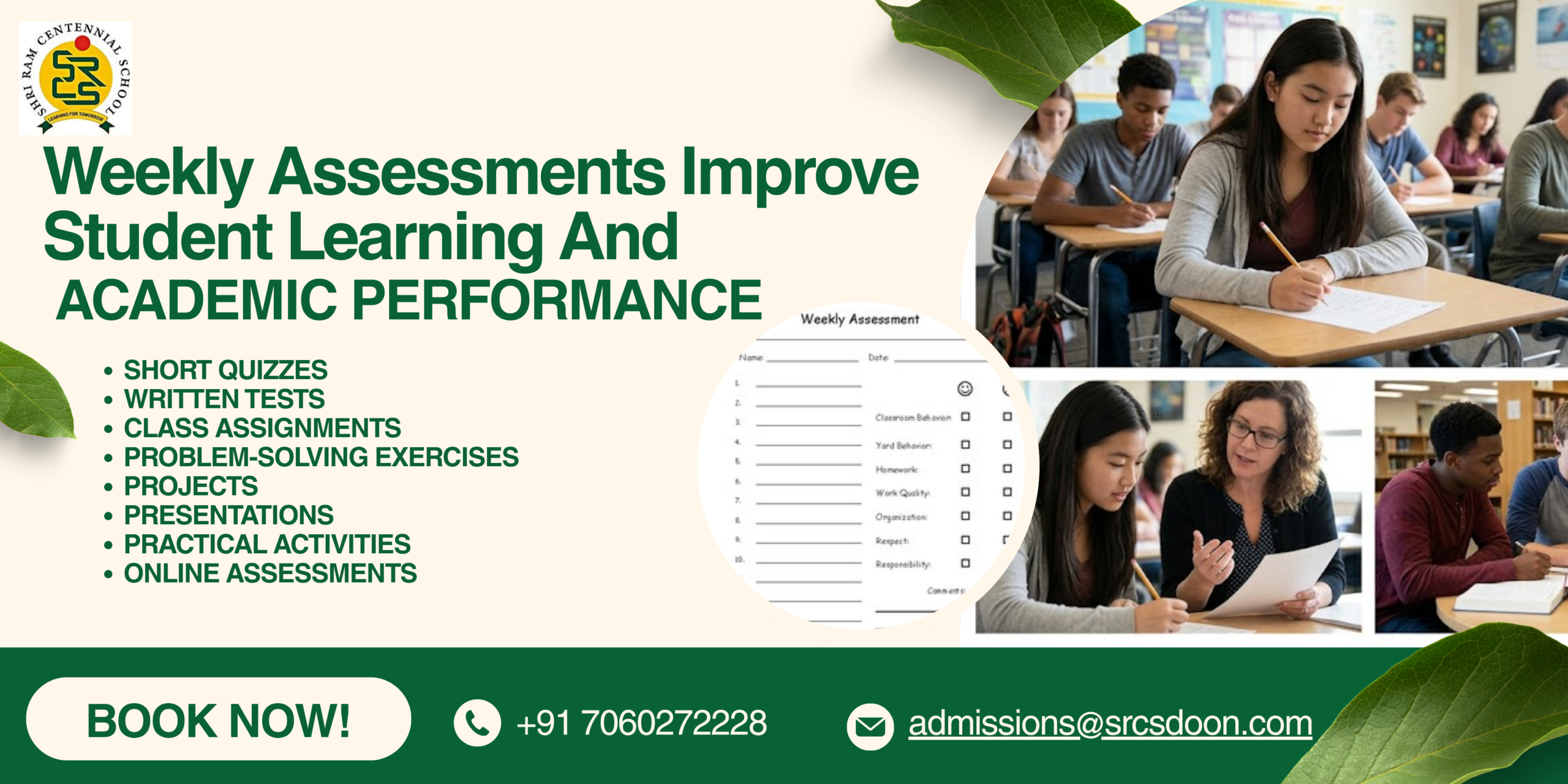
They may include:
- Short quizzes
- Written tests
- Class assignments
- Problem-solving exercises
- Projects
- Presentations
- Practical activities
- Online assessments
The format can vary depending on the subject and learning objectives.
The goal is to check whether students have understood the concepts taught during the week and provide useful feedback for further learning.
1. Identifies Learning Gaps Early
The benefit of weekly assessments is that they may assist in uncovering learning gaps before they’d be too challenging to be corrected.
For instance, a weekly assessment might be used to identify that a student has not internalized an important mathematical idea if that is the case. The teacher can then give further explanation or practice before adding in any higher level concepts.
This means that student learning assessment is not just prior to big tests, but it is continuous.
2. Provides Regular Feedback
Feedback is an important part of effective learning.
A student may know that an answer is incorrect but may not understand why. Regular assessments give teachers opportunities to identify mistakes and explain how students can improve.
Useful feedback can help students understand:
- What they have learned successfully
- Where they made mistakes
- Which concepts require more practice
- How they can improve their answers
- What they should focus on next
Timely feedback is generally more useful than receiving comments several months after a topic was taught.
3. Encourages Consistent Study Habits
When students know that they have regular assessments, they may be more likely to review lessons consistently instead of depending entirely on last-minute preparation.
This can encourage:
- Regular revision
- Better time management
- Consistent practice
- Improved organisation
- Greater familiarity with course material
The aim should not be to create constant pressure. Assessments should remain appropriately sized and focused on meaningful learning objectives.
4. Improves Academic Performance
Academic performance can improve when students receive regular opportunities to identify and correct weaknesses.
Instead of waiting for a major examination to discover that several topics have not been understood, students can address those areas progressively.
For example:
Learn → Assess → Receive Feedback → Improve → Reassess
This cycle can help students build stronger foundations over time.
However, weekly assessments are not automatically effective. Their value depends on how the results are used. Simply giving students more tests without providing feedback or support is unlikely to produce the same benefits.
5. Reduces the Pressure of Major Examinations
When students have to revise a whole term or school year at a time, large examinations can be overwhelming.
Learning is divided into smaller sections through regular assessments. Students will thus get to know how to respond to questions and how to use concepts all year long.
This can assist with a more structured approach to exam preparation and with reducing last-minute revision.
6. Helps Teachers Adapt Their Teaching
Assessment is useful not only for students but also for teachers.
Results can show whether a particular concept has been understood by most of the class or whether additional teaching is necessary.
For example, if many students struggle with the same topic, a teacher may:
- Re-explain the concept
- Use a different teaching method
- Provide additional examples
- Introduce practical activities
- Give targeted practice
This makes assessment part of the teaching process rather than simply a method of assigning marks.
7. Supports Individual Learning Needs
Pupils learn at different speeds.
Regular evaluation of student learning can provide information for teachers to assess student strengths and weaknesses. For some, there may be tasks they need to work on further, and for others there may be more challenging tasks.
This information can help inform more personalised learning.
Teachers can make informed decisions on what further support and enrichment needs to be given to the class based on the assessment results as opposed to assuming that they all have the same needs.
8. Develops Self-Assessment Skills
Students can also learn to evaluate their own progress.
After receiving feedback, they can ask the following:
- What did I understand well?
- Where did I make mistakes?
- Why did I make those mistakes?
- What should I practise?
- What strategy can I use next time?
This encourages students to take greater responsibility for their learning.
Over time, students can become more aware of how they learn and which strategies work best for them.
9. Creates a Continuous Assessment Cycle
Continuous assessment means evaluating student learning regularly rather than relying exclusively on final examinations.
Weekly assessments can contribute to this process by providing frequent information about progress.
A continuous assessment approach can include a combination of:
- Quizzes
- Classwork
- Projects
- Practical tasks
- Presentations
- Assignments
- Unit tests
Using different assessment methods can provide a broader picture of student learning than relying on one examination format.
10. Encourages Better Preparation for Future Studies
Students can get used to academic routines that they might have when they enter higher education if they have regular assessments.
They develop time-management skills, learn to make continual revisions, take feedback and get ready for assessment.
These habits can prove helpful as students advance to higher levels of education where more rigorous study and preparation are expected.
Weekly Assessments Should Not Become Excessive Testing

There is an important distinction between regular assessment and excessive testing.
More tests do not automatically mean better learning.
If weekly assessments are too long, too difficult, or overly focused on marks, they may create unnecessary stress and encourage students to study only for tests.
Effective assessments should therefore be:
- Short and focused
- Aligned with learning objectives
- Appropriate for the student’s age
- Followed by useful feedback
- Used to guide future teaching
- Balanced with projects and other learning activities
The objective should be better learning, not simply more testing.
How Parents Can Support Assessment-Based Learning
Parents can also help children make constructive use of assessment results.
Instead of focusing only on marks, ask questions such as:
“What did you learn?”
“Which topic was difficult?”
“What can you improve before the next assessment?”
This shifts the focus from simply achieving a particular score to understanding the learning process.
Parents can also encourage regular revision, adequate rest, organised study routines, and asking teachers for help when necessary.
The Role of Feedback in Weekly Assessments

Feedback is arguably one of the most important parts of the assessment process.
A score alone tells students how they performed, but detailed feedback can explain how they can improve.
Effective feedback should be:
- Specific
- Clear
- Timely
- Constructive
- Related to the learning objective
For example, instead of simply saying that an answer is incorrect, a teacher can explain which part of the reasoning needs improvement and provide an example of a stronger approach.
This turns assessment into a learning opportunity.
Weekly Assessments and Holistic Student Development
Although assessments primarily measure academic learning, they can also contribute to broader student development when used appropriately.
Students can develop:
- Time management
- Organisation
- Self-discipline
- Goal setting
- Reflection
- Responsibility
- Confidence
The key is to ensure that assessment remains one part of a broader educational experience that also includes sports, creative activities, teamwork, leadership, and social development.
Conclusion
When meaningful learning goals are used, weekly assessments can be an effective way to improve learning. They make it easy to locate learning gaps, to give timely feedback, to spur student revision, and to offer teachers information about student progress.
They can also be beneficial for the students’ academic performance as they can allow students to solve problems before major examinations.
But it’s not about increasing the number of tests. Assessment is about developing understanding of learning and applying that to enhance it.
Assessments should be conducted on a weekly basis, combined with good teaching, constructive feedback, personalised support and a balanced educational context, so that assessments can be a valuable aspect of student learning assessment and continuous assessment.
Frequently Asked Questions
Q1. What are weekly assessments?
Ans: Weekly assessments are regular, usually short evaluations designed to check students’ understanding of recently taught concepts and identify areas that need further attention.
Q2. How do weekly assessments improve academic performance?
Ans: They can help students identify weaknesses early, receive timely feedback, revise consistently, and address learning gaps before major examinations.
Q3. What is student learning assessment?
Ans: Student learning assessment is the process of evaluating what students understand, what they can apply, and where they may need additional support.
Q4. Are weekly assessments better than final examinations?
Ans: They serve different purposes. Weekly assessments provide regular feedback during the learning process, while final examinations generally evaluate learning over a larger period. A combination of assessment methods can provide a more complete picture of student progress.
Q5. What is continuous assessment?
Ans: Continuous assessment involves evaluating student learning regularly throughout the academic period rather than relying only on one final examination.