



Character education in schools plays an important role in preparing students for life beyond the classroom. Academic performance can help students progress through their education, but marks alone cannot teach them how to make responsible decisions, treat others with respect, handle challenges, or contribute positively to society.
Therefore, a well-balanced education must be combining both academics and personal growth. Character education for students fosters traits like honesty, empathy, responsibility, discipline, respect, resilience, and integrity.
This is not to say that marks are of no importance. Academic achievement matters. Education, however, is more meaningful when students use their knowledge responsibly and acquire values so they can apply their knowledge in real life.
What Is Character Education in Schools?

Character education in schools means intentional development of positive values, attitudes, behaviours and personal character in school students.
It can be fostered in the classroom, in school activities, in sports, in leadership programmes, in community service activities, in group projects, and in daily interactions with teachers and students.
Important values may include:
- Honesty
- Respect
- Responsibility
- Empathy
- Integrity
- Discipline
- Fairness
- Kindness
- Perseverance
- Accountability
These values are not developed through a single lesson. They are strengthened through consistent experiences and positive examples.
Why Do Values Matter Alongside Academic Marks?
Marks may be used to show the performance of a student in one assessment. But they can’t really assess characteristics like honesty, compassion, resilience, teamwork or responsibility.
Think about two students who have similar academic outcomes. One might be very responsible, cooperative, respectful, willing to assist others, etc., while another might not be able to work well in a team or work through setbacks.
They could be awarded the same mark, but their overall ability and attitude can have an impact on what they will do next.
This is why character education for students should complement academic learning rather than compete with it.
1. Character Education Builds Responsibility
Responsibility is an important quality for students to develop.
Schools can encourage responsibility by giving students appropriate roles and allowing them to take ownership of their work and decisions.
Students can learn responsibility through:
- Completing assignments on time
- Caring for shared spaces
- Participating in group projects
- Taking leadership roles
- Following school rules
- Accepting the consequences of their decisions
These experiences can gradually help students become more accountable for their actions.
2. It Encourages Honesty and Integrity
A degree, a diploma, or even a diploma in justice does not matter if it is gained through dishonesty.
It is important for students to learn the value of honesty in school assignments and in their relationships with others and this may be taught through character education in schools.
Pupils can be taught that integrity involves doing the right thing when no one is looking.
It may be telling the truth when things go wrong, not using unfair means, respecting others’ work and being responsible when things go wrong.
3. It Develops Respect and Empathy
Students meet others who have different views, backgrounds, skills and experiences.
Educating students to listen respectfully and comprehend differing points of view can assist them in building empathy.
Students are able to learn about the impact of their words and actions through classroom conversations, team activities, sports and community engagement.
It is the hope of these experiences that students will become more considerate members of their community, and this will positively impact their moral and ethical development.
4. It Helps Students Handle Failure
Life in the academic arena is full of its share of disappointments. Students may not get the marks they deserve, miss a competition, make errors or not do well in a certain subject.
With character development, students can be taught to see that failure is not a measure of their capability.
A spirit of perseverance, resilience, patience and self-discipline can help students to turn negative experiences into positive learning opportunities.
This is something that test points cannot impart.
5. It Strengthens Leadership Skills
Leadership is about more than holding a title.
Good leaders need responsibility, fairness, communication, empathy, decision-making ability, and integrity.
Schools can provide character education for students through opportunities such as:
- Student councils
- Sports teams
- Clubs
- House activities
- Group projects
- Community initiatives
- School events
When students are trusted with responsibilities, they can learn how their decisions affect other people.
6. It Improves Teamwork and Cooperation
There are hardly any actual accomplishments that occur in isolation.
Students will ultimately need to work in teams with friends, the community, colleagues, and classmates.
Group activities can help students develop the skills of sharing responsibility, listening to other people’s points of view, settling differences and collaborating to reach a shared goal.
These experiences help promote respect and co-operation.
7. It Supports Moral and Ethical Development
Moral and ethical development helps students think about what is right, fair, responsible, and respectful.
Rather than telling students what to do or not do, instructors can engage them in conversation about situations, different points of view and implications of their decisions.
For instance, students can talk about questions of fairness, responsibility, environmental protection, digital behaviour, or about helping others.
These conversations can help them make thoughtful decisions.
How Schools Can Promote Character Education

Character development works best when values are reflected throughout the school environment rather than taught only as a separate subject.
Schools can promote character through:
Classroom Learning
Teachers can incorporate discussions about responsibility, respect, honesty, teamwork, and ethical decision-making into different subjects.
Sports and Activities
Sports can teach discipline, teamwork, perseverance, fairness, and respect for opponents.
Community Service
Community projects can help students understand social responsibility and the importance of contributing to others.
Leadership Opportunities
Giving students meaningful responsibilities can help them practise decision-making and accountability.
Teacher Role Models
Students often learn from what adults do, not only what they say. Teachers and school staff who demonstrate respect, fairness, honesty, and responsibility can provide powerful examples.
Character Education Does Not Mean Ignoring Academic Achievement
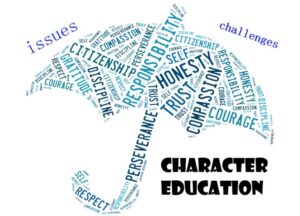
There is a common misconception that focusing on values means lowering academic expectations.
That is not the case.
Strong character education in schools should work alongside rigorous academic learning. Students need knowledge and intellectual skills, but they also need the personal qualities to use those abilities responsibly.
The better question is not whether schools should prioritise marks or values.
It is how schools can help students develop both academic competence and strong character.
How Parents Can Support Character Development
Character development continues outside school.
Parents can reinforce positive values by:
- Encouraging honesty
- Giving children age-appropriate responsibilities
- Listening to their opinions
- Discussing the consequences of decisions
- Praising effort and responsible behaviour
- Encouraging children to help others
- Teaching respectful communication
- Allowing children to learn from appropriate mistakes
Parents do not need to expect perfection. Consistent guidance and positive examples can be more effective than simply telling children what values they should have.
Character Matters Beyond the Classroom

Eventually students transition out of school and into universities, workplaces and communities.
They will find some situations where there is no examination paper with the right answer.
They might want to confess a wrongdoing, assist a teammate, stand up for someone, handle a disagreement, or be responsible for an essential choice.
In such cases, judgement and character will come into play.
That is why character education for students has relevance far beyond school life It can equip students with attributes that will be useful in any job or course of study they undertake later in life.
Conclusion
Character education in schools reminds us that education is about more than examination results. It is not possible to measure performance on marks for honesty, empathy, responsibility, resilience, leadership or integrity.
While academic performance is important, it is also essential that students develop good values so that they can apply their knowledge in a responsible and effective way.
Character education can be effectively implemented in school through meaningful experiences, caring teachers, opportunities for leaders, collaboration, athletics, community service, and positive role models, while still maintaining rigorous academic standards.
The aim of education should not just be to get high marks. It should be designed to help young people develop into knowledgeable, responsible, ethical and capable individuals who can make positive choices and decisions for themselves in the world around them.
Frequently Asked Questions
Q1. What is character education in schools?
Ans: Character education in schools is the intentional development of values and personal qualities such as honesty, respect, responsibility, empathy, integrity, discipline, and resilience.
Q2. Why is character education important for students?
Ans: Character education for students helps them develop personal and social qualities that academic marks cannot fully measure, including responsibility, empathy, teamwork, integrity, and resilience.
Q3. How does character education support moral and ethical development?
Ans: It gives students opportunities to discuss values, understand different perspectives, consider consequences, and practise responsible decision-making. These experiences contribute to moral and ethical development.
Q4. Does character education replace academic learning?
Ans: No. Character education should complement academic learning. Students need both strong academic foundations and the values and skills required to apply their knowledge responsibly.
Q5. How can schools develop good character in students?
Ans: Schools can encourage character development through classroom discussions, sports, leadership programmes, community service, group projects, extracurricular activities, clear expectations, and positive role modelling.