





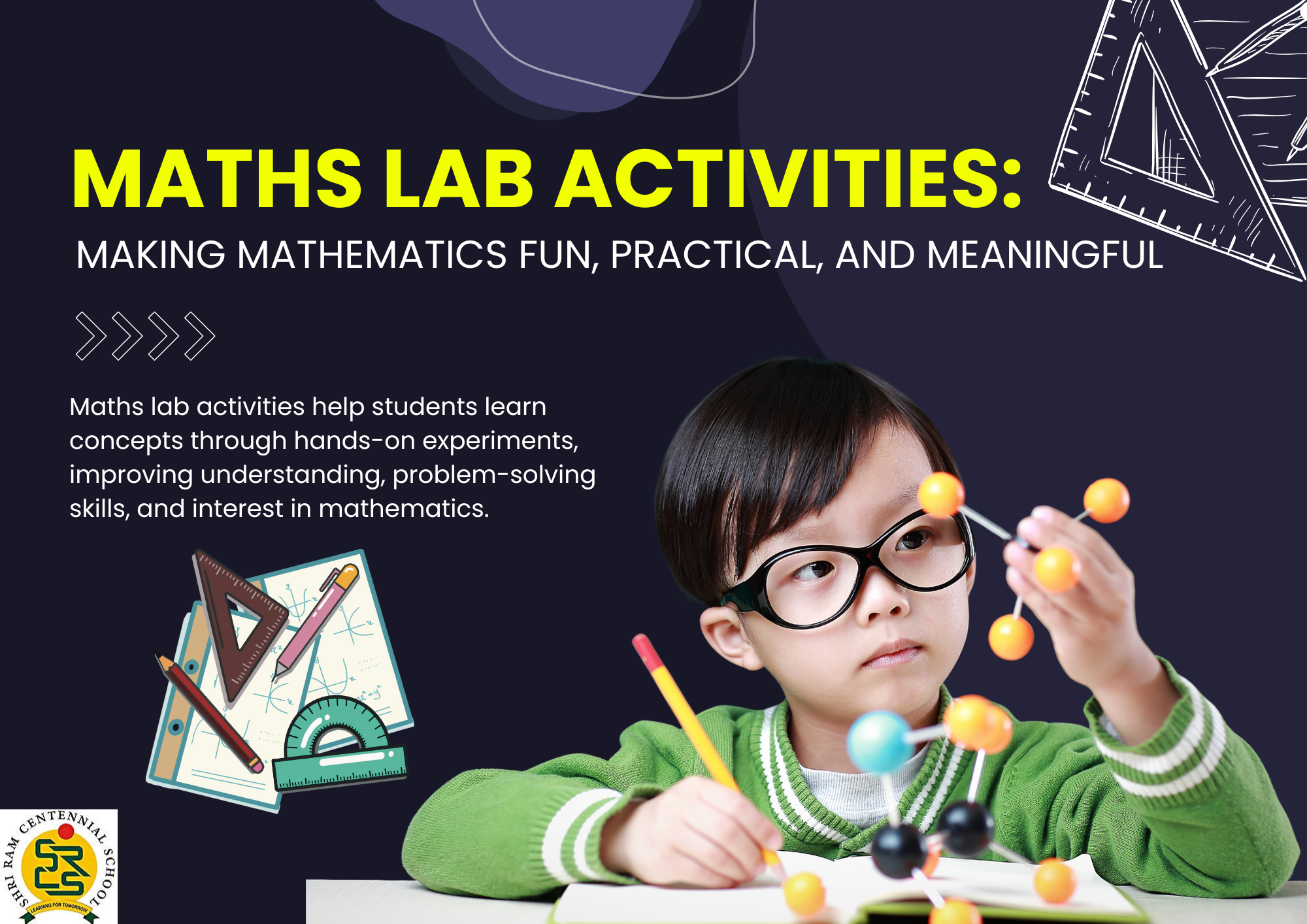
Struggling to understand maths concepts even after repeated practice? You’re not alone. Many students find mathematics confusing when it is taught only through formulas and theory. That’s where Maths Lab Activities come in—they transform complex ideas into simple, hands-on learning experiences. Mathematics is often seen as a subject full of numbers, formulas, and problem-solving. However, learning maths does not have to be limited to textbooks and blackboards.
In today’s evolving education system, students are encouraged to learn by doing rather than memorizing formulas. This approach not only improves conceptual clarity but also builds confidence and curiosity among learners. Whether in classrooms or school labs, these activities bring mathematics to life in a meaningful way.
What Are Maths Lab Activities?

Maths Lab Activities are hands-on learning methods that help students understand mathematical concepts through practical experiments, models, and interactive tasks instead of rote memorisation.
These activities allow students to explore patterns, relationships, and problem-solving techniques in a more engaging and effective way.
Why Maths Lab Activities Are Important in Modern Education

In today’s Modern Education system, learning is no longer limited to textbooks. Schools are shifting toward experiential learning to build real-world skills.
Key Reasons They Matter
-
Help students understand abstract concepts easily
-
Encourage active participation
-
Improve logical and analytical thinking
-
Reduce fear of mathematics
Studies show that activity-based learning improves retention by up to 70–75%, making it one of the most effective teaching methods.
10 Maths Lab Activities That Make Learning Easy

1. Triangle Angle Sum Activity (Geometry)
Objective: Verify that the sum of angles in a triangle is 180°
Materials: Paper, scissors, ruler
Method: Cut a triangle and tear its angles. Arrange them in a straight line to form 180°.
2. Fraction Circle Activity
Objective: Understand fractions visually
Method: Divide a circle into equal parts to represent fractions like 1/2, 1/4, etc.
3. Algebra with Matchsticks
Objective: Learn linear equations
Method: Use matchsticks to form equations and solve them practically.
4. Number Line Activity
Objective: Understand integers
Method: Draw a number line and use steps to represent addition and subtraction.
5. Symmetry Mirror Activity
Objective: Identify symmetry
Method: Use a mirror to check lines of symmetry in shapes.
6. Probability with Dice
Objective: Learn probability basics
Method: Roll a dice multiple times and record outcomes.
7. Bar Graph Activity
Objective: Understand data handling
Method: Collect classroom data and represent it using graphs.
8. Volume Measurement Activity
Objective: Learn volume concepts
Method: Use containers to measure liquids and compare volumes.
9. Multiplication Grid Activity
Objective: Simplify multiplication
Method: Use grids to visually solve multiplication problems.
10. Area Calculation Activity
Objective: Understand area formulas
Method: Measure classroom objects and calculate their area.
Objectives of Maths Lab Activities
The main goals of introducing math lab activities in schools include:
Promoting learning through exploration
Developing reasoning and critical thinking
Connecting maths with real-life situations
Encouraging teamwork and discussion
Enhancing creativity and confidence
Maths Lab Activities vs Traditional Learning
| Maths Lab Activities | Traditional Learning |
|---|---|
| Hands-on learning | Theory-based |
| Concept clarity | Memorisation |
| Interactive | Passive |
| Real-life application | Abstract |
Benefits of Maths Lab Activities for Students
1. Strong Conceptual Clarity
Students understand the “why” behind formulas.
2. Higher Engagement
Interactive learning makes maths interesting.
3. Better Retention
Students remember concepts longer through practice.
4. Improved Problem-Solving Skills
Real-life application enhances logical thinking.
5. Confidence Building
Students overcome fear and gain confidence.
How Schools Can Implement Maths Lab Activities Effectively

-
Set up a dedicated maths lab
-
Use low-cost teaching materials
-
Conduct weekly lab sessions
-
Train teachers in activity-based methods
-
Align activities with the curriculum
You can explore structured guidelines from: 👉https://www.srcsdoon.com/
Conclusion: Why Maths Lab Activities Are the Future
Maths Lab Activities are changing the way students learn mathematics. By combining theory with practical application, they make learning easier, more engaging, and highly effective.
In today’s education system, these activities are not just an option—they are essential. They help students build strong concepts, improve performance, and develop skills that go beyond the classroom.
FAQ Section
1. What are Maths Lab Activities?
Maths lab activities are practical learning methods where students understand mathematical concepts through experiments and hands-on tasks.
2. Why are Maths Lab Activities important?
They improve conceptual understanding, increase engagement, and make learning mathematics easier and more effective.
3. How do Maths Lab Activities help students?
They enhance problem-solving skills, boost confidence, and improve long-term retention.
4. Can Maths Lab Activities be done at home?
Yes, many activities can be done using simple materials like paper, rulers, and household objects.
5. Are Maths Lab Activities part of school curriculum?
Yes, many education boards encourage activity-based learning as part of modern teaching methods.