

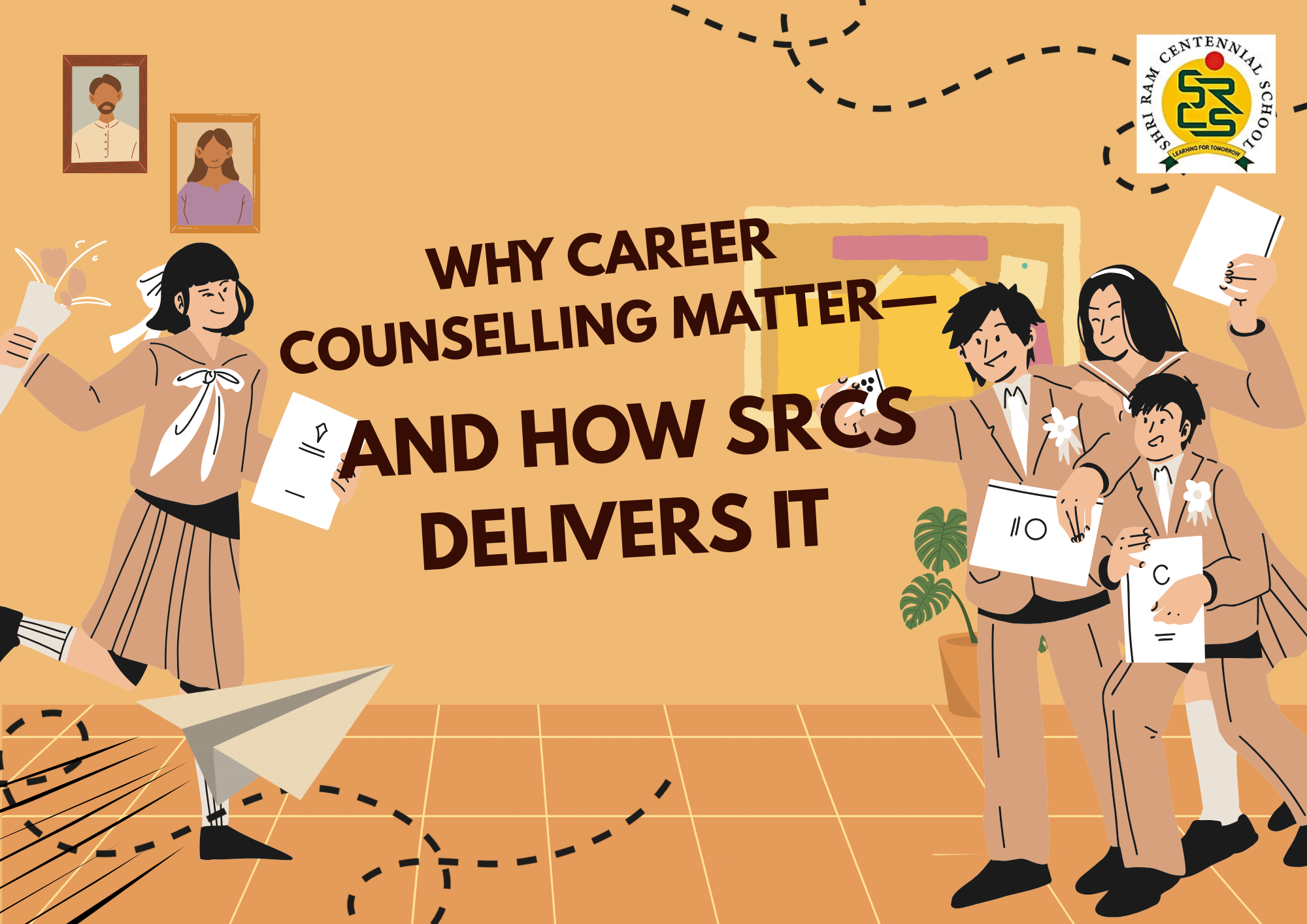
Choosing the right career is one of the most important decisions a student makes, yet many young learners struggle to identify the right path among countless courses, programs, and career opportunities. Career counselling in schools provides students with structured guidance to understand their interests, strengths, abilities, and future aspirations.
Instead of choosing a career based only on academic marks, peer influence, or family expectations, students can explore different possibilities and make informed decisions about their future. At SRCS, career counselling plays an important role in helping students discover their potential, understand suitable career pathways, and develop the confidence needed to plan their academic and professional journey.
Why is Career Counselling in Schools important for Students?
The process of choosing academic stream, subjects and institutions, and then career choice, comes with a lot of pressure for students. Sometimes, an uninformed decision can cause confusion or dissatisfaction in the long run. Career counselling offers students an opportunity to delve into different possibilities before making any critical academic decisions.
Reliable career counselling will help students gain a clearer understanding of their interests, personality traits, inherent strengths, and areas that they need to work on. This also expands their awareness of the career options they may not have been aware of. For example, a student who has a passion for science will immediately gravitate towards becoming an engineer or doctor. Career guidance, however, can introduce them to other careers such as biotechnology, data science, environmental studies, research, healthcare management and many emerging careers.
This broad view will allow students to make decisions for themselves in accordance with their own potential rather than just the path that has been taken.
Nurturing Student Strengths

Each of our students has special talents. Some are outstanding in their studies; some are highly creative, leadership, communicative, problem solving or skill full in practical aspects. A properly designed career counselling programme can be used to effectively identify these strengths and guide students to consider career options that match their strengths.
Students at SRCS are encouraged to think about what they can do and what they enjoy at the same time investigating possible academic and occupational options. This helps the individual to become self-aware and gain confidence. It is important to recognize personal abilities particularly at a stream selection stage when students are looking into what they are good at. Students’ decision for science, commerce, humanities or other academic streams is now guided as they are aware of their interests and aspirations.
Making informed academic choices easier.
Choices of careers are tied to academic decisions. Students should be made aware of the implications that have implications for their future choices of subjects and University admission. Career guidance helps to provide answers to questions such as:
- What subjects would be good to add to my interests?
- What are the opportunities for employment in this area?
- What are the requirements and qualifications?
- What exams will I have to sit for entry?
- What skills do I need to build up in the future?
- What are the possibilities for me in higher education?
These questions are not only essential for students to think about but also crucial to planning their academic trajectory with a clear sense of direction.
Getting ready for a Changing Career World

The business environment is changing. New technologies, artificial intelligence, automation and new industries are constantly evolving and creating new jobs. Thus the need to promote career awareness among students is of paramount importance. Career counselling can help develop the knowledge of emerging areas and the skills required to excel in these areas.
SRCS strives to teach students to think in new ways. Students can be encouraged to consider innovative work rather than just the traditional and to think about how their existing interests can be applied to a future job market.
This booklet provides guidance for Higher Education and University Planning.
Career counselling is not just about career exploration, it is also about planning higher education. Students frequently require help researching and locating information on:
- Universities and colleges
- Undergraduate programs
- Entrance examinations
- Eligibility criteria
- Subject combinations
- Scholarships
- International education opportunities
By providing good guidance, students can start preparing for their future years ahead of time and thereby can avoid last moments’ stress and have better choices about applying to universities.
Increase Confidence and Decrease Career Confusion
One of the most important advantages of having a career counselling is that it reduces uncertainty. Students tend to compare themselves to other students or feel compelled to pursue the most sought after careers. Student understand that success is measured in many different ways and that there is not one ‘right’ career for every student.
When a student understands his/her interests and goals, he/she is more likely to make academic decisions with confidence.
Further, by providing career counselling, students can make decisions about their future, instead of waiting for others to make them.
SRCS supports Career Development in a variety of ways.
SRCS believes in a comprehensive student development approach as it knows education is beyond books and exams. This is done as a central element of this holistic development, connecting the learning to the future, including career guidance. Students are exposed to a range of careers through counselling, and have the opportunity to explore alternate pathways through career focussed activities, all the while recognising their strengths.
Students’ conversations with mentors and educators help them reflect on their decisions and establish realistic objectives.
The goal is not to set a career trajectory but to encourage students to ask themselves the right questions, consider options, and select courses and options that match their talents and interests.
Get students ready for a life beyond school.

The ultimate goal of career counselling in school is to educate students for life after school. Career planning provides students with the necessary skills to make decisions, self-awareness, confidence and clarity of direction. Career guidance provides support to complement the academic learning that happens at SRCS, and encourages students to begin to consider their future from an early age.
Conclusion
Career choices can have significant consequences, and advice at an opportune time and in an appropriate way is crucial. A cornerstone in career counselling for school students is providing them with information about their strengths, career options, future career opportunities and their choices about post-school education. SRCS is dedicated to offering students all the support they need for both their studies and their lives to lead successful and rewarding lives after they leave school.
Frequently Asked Questions.
Q1. Career counselling is important to students because of the following reason?
Ans. Career counselling assists students in becoming aware of their interests, strengths, abilities and aspirations so that they can have a correct decision making process for their academic and career decision.
Q2. Career counselling helps students to choose their career?
Ans. It offers students guided information and ideas about a variety of careers depending on their interests, aptitudes, skills and aspirations, rather than just on marks and peer pressure or family expectations.
Q3. When should Career Counselling be offered to students?
Ans. Career counselling can be useful to students at various points in their schooling. The early guidance can assist in developing awareness of their interests and counselling during secondary and senior secondary years can assist in making subject and career choices.
Q4. What is the percentage of students in each grade level that have received career counselling?
Ans. Support provided to students at SRCS includes career guidance that helps students identify what they are good at, what course options are available and to them and what they should consider when choosing a course.