




Most students have experienced this: you read a chapter, close the book, and moments later can barely recall what it said. It is not a memory problem. It is a method problem. Reading without a structured approach often produces surface-level understanding that evaporates under pressure — especially during exams.
This is where the SQ3R method comes into play. It is a proven reading strategy designed to improve comprehension, memory, and overall academic performance. Whether you are studying in a school in India, preparing for competitive exams, or simply trying to improve your study habits, this method can make a real difference.
What Is the SQ3R Method? Breaking Down Each Step
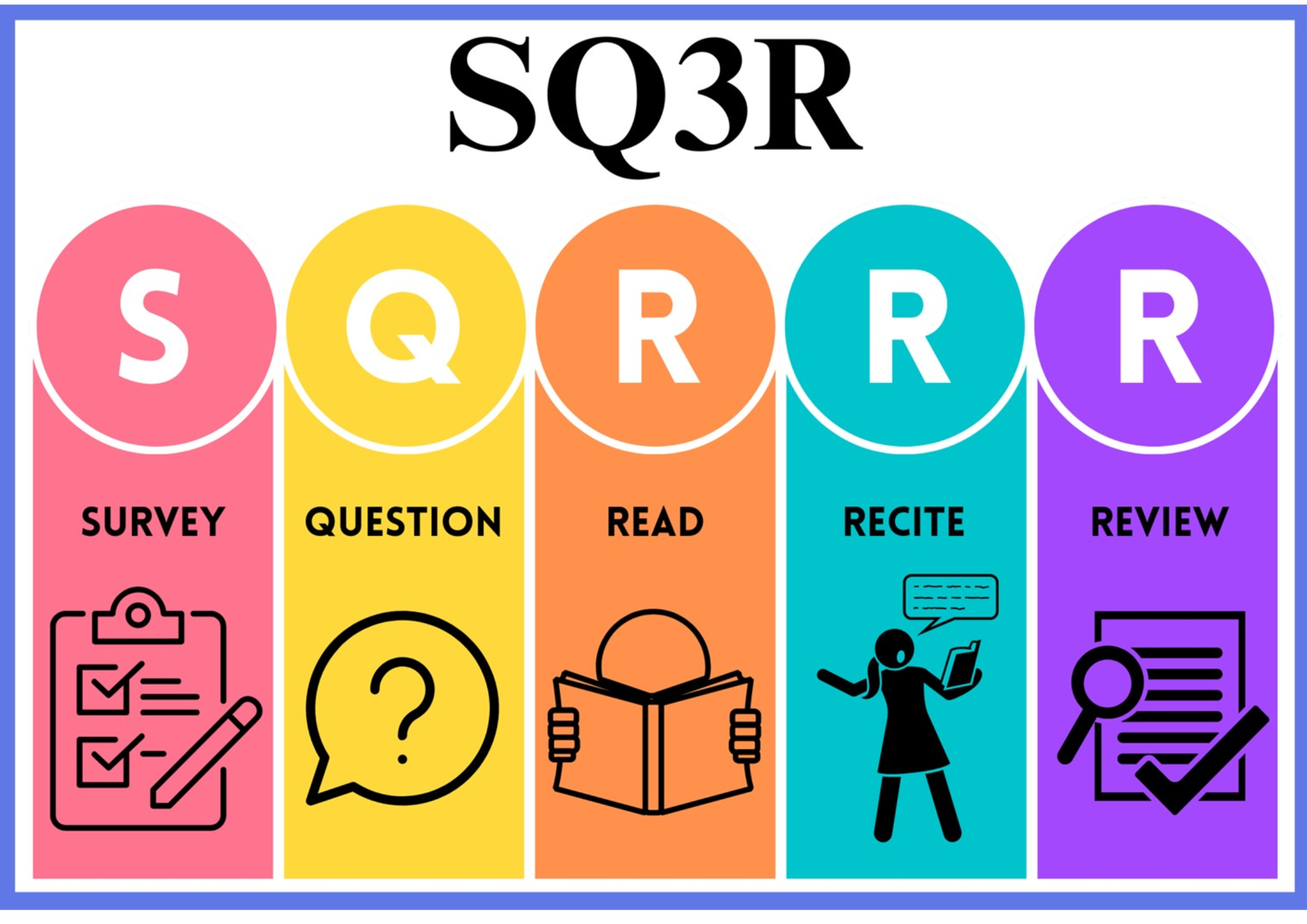
SQ3R is an acronym that stands for Survey, Question, Read, Recite, and Review. Each step is intentional and builds on the previous one. Together, they create a learning loop that improves both comprehension and long-term retention.
The SQ3R method stands for:
- S – Survey
- Q – Question
- R – Read
- R – Recite
- R – Review
Step 1: Survey
Before diving into the actual text, students take a few minutes to survey the material. This means scanning the headings, subheadings, images, captions, introductory paragraphs, and summaries. The goal is to build a mental framework before any detailed reading begins. Think of it as reading the map before starting the journey.
Step 2: Question
Once the survey is complete, students convert each heading or section title into a question. For example, a heading like “The Water Cycle” becomes “What is the water cycle, and why does it matter?” This deceptively simple step does something powerful — it gives your brain a target. You are no longer reading to fill time; you are reading to find an answer.
Step 3: Read
Now comes the actual reading — but with a focused purpose. Students read each section actively, looking specifically for answers to the questions they formed. This is not speed-reading or skimming. It is purposeful, engaged reading where attention stays anchored to meaningful content rather than drifting.
Step 4: Recite
After reading each section, students close the text and try to recall the key ideas in their own words. They can say it aloud, write it down, or explain it to an imaginary listener. This step is where memory consolidation actually begins. If a student cannot recite the main points after reading, that section deserves another pass before moving on.
Step 5: Review
The final step happens after the entire reading is complete. Students go back over their notes, revisit key sections, and test themselves against the questions they originally formed. This review stage transforms short-term retention into long-term understanding — the kind that holds up weeks later in an exam room.
Why the SQ3R Method Works: The Science Behind It

The SQ3R method is not popular simply because it is old — it has endured because it aligns with how the human brain actually processes and stores information. Its effectiveness can be traced to several well-established principles of learning science.
First, it activates prior knowledge before introducing new material, which lowers cognitive load and makes new information easier to absorb. Second, the question-forming step triggers a state of curiosity, and research consistently shows that people remember information better when they are genuinely looking for an answer.
Third, the recite step leverages retrieval practice — one of the most robust findings in memory research. When you force yourself to recall something from memory, rather than simply rereading it, you strengthen the neural pathways associated with that information. The review step then adds spaced repetition, another evidence-backed technique for durable learning.
All of this directly supports Cognitive Development in students — especially during the formative years when the brain is still building the mental frameworks needed for critical thinking, analysis, and academic performance.
SQ3R in the Indian Academic Landscape

India’s education system is deeply rooted in curriculum coverage and exam performance. Students are often expected to absorb dense textbooks within a limited academic calendar. In this environment, reading efficiency is not a luxury — it is a necessity.
The SQ3R method is particularly well-suited to this context. It helps students navigate information-heavy textbooks methodically, extract key ideas with precision, and retain them over longer periods. Teachers and school counselors across the country have begun recommending structured reading frameworks as an alternative to last-minute cramming, which may produce short-term gains but rarely builds lasting competence.
Residential institutions have also recognized the value of structured study habits. Co-ed Boarding schools in India often integrate active learning techniques like SQ3R into their supervised study programs, helping students develop independent learning skills alongside academic knowledge. The structured schedule of a boarding environment creates the ideal conditions for consistent application of this method.
Meanwhile, Day boarding schools in India have found the method equally practical. Students who attend extended-day programs benefit from guided study periods where teachers can introduce and model the SQ3R framework, ensuring it becomes a habit rather than a one-time exercise.
Key Benefits of the SQ3R Method

The advantages of adopting this method go well beyond simply “reading better.” Here is what students and educators consistently report after sustained use:
- Stronger comprehension — students understand material at a deeper level because they engage with it rather than just moving their eyes across the page.
- Better exam preparation — because the method includes built-in self-testing through the Recite and Review steps, students arrive at exams with information that has already been retrieved multiple times.
- Reduced study time — counterintuitively, reading with a method is often faster than unfocused reading because students waste less time rereading confused sections.
- Greater academic confidence — students who know how to approach a difficult text feel less overwhelmed, which reduces study anxiety significantly.
- Transferable skills — the habit of converting information into questions and then verifying answers is a core thinking skill that extends well beyond academics into professional and daily life.
Challenges of Using the SQ3R Method

While the SQ3R method is effective, it may not feel easy at first. Like any new habit, it requires practice and patience.
Common Challenges
1. Time-Consuming Initially
Students may feel it takes longer than normal reading. However, it saves time in the long run.
2. Requires Discipline
Following all five steps consistently can be difficult without self-control.
3. Not Suitable for All Content
Some subjects, like mathematics, may require different approaches.
4. Needs Practice
The method becomes effective only when used regularly.
Despite these challenges, once students adapt to the process, it becomes a natural and efficient way of learning.
Practical Tips to Use SQ3R Effectively
To get the best results from this method, students can follow a few simple tips:
- Start with one subject and gradually apply it to others
- Keep a notebook for writing questions and summaries
- Study in a distraction-free environment
- Practice daily to build consistency
- Combine SQ3R with revision schedules
Parents and educators can also guide students in adopting this method, especially during early academic years.
Who Can Benefit from SQ3R?
The SQ3R method is not limited to a specific group of learners. It can benefit:
- School students preparing for exams
- College students handling large volumes of reading
- Competitive exam aspirants
- Lifelong learners aiming to improve comprehension
Its flexibility makes it suitable for different learning and best environments and academic levels.
Conclusion
The SQ3R method is more than just a reading technique—it is a complete learning strategy. By following a structured approach of surveying, questioning, reading, reciting, and reviewing, students can transform the way they study.
It offers a balanced mix of understanding, retention, and application, making it highly effective for modern education systems. While it may require effort in the beginning, the long-term benefits far outweigh the initial challenges.
For students aiming to improve their academic performance and build strong learning habits, the SQ3R method is a simple yet powerful tool worth adopting.
Frequently Asked Questions
1. What is the SQ3R method in simple terms?
The SQ3R method is a structured study technique that helps students understand and remember information better. It involves five steps—Survey, Question, Read, Recite, and Review—to make learning more active and effective.
2. How does the SQ3R method improve memory?
The method improves memory by encouraging students to actively engage with the content. Steps like reciting and reviewing help transfer information from short-term to long-term memory, making it easier to recall during exams.
3. Is the SQ3R method suitable for all subjects?
SQ3R works best for theory-based subjects like history, biology, and literature. While it can still be helpful for other subjects, practical or numerical topics may require additional problem-solving techniques.
4. Can beginners easily use the SQ3R method?
Yes, beginners can use it, but it may feel time-consuming at first. With regular practice, students become more comfortable, and the method becomes faster and more effective.
5. How often should students use the SQ3R method?
Students should use the SQ3R method regularly, especially while studying new chapters or preparing for exams. Consistent use helps develop better study habits and improves overall learning efficiency.